


Your best engineer just spent the first 45 minutes of their shift staring at a service board with 200 open tickets — and they haven’t touched a single one yet.
Sound familiar? This isn’t a time management problem. It’s a cognitive load problem. And it’s costing your MSP real money, real clients, and very real technician burnout.
Managed Service Providers are built on the promise of fast, reliable, and accurate support. But before any ticket gets resolved, someone has to answer the eternal question: What do I work on next?
For most MSPs, that question gets answered by whoever happens to be logged in at the time — using gut instinct, tribal knowledge, and a queue that prioritizes whoever screams loudest. The result? Brilliant engineers wasting their best cognitive hours on administrative triage instead of technical resolution. In this post, we’re breaking down the hidden cost of technician decision fatigue and how MSPbots’ NextTicket is designed to eliminate it entirely.
What Is Decision Fatigue — and Why Should MSPs Care?
Decision fatigue is the psychological phenomenon where the quality of decisions deteriorates after a sustained period of making many choices. Research into cognitive science consistently shows that our capacity for deliberate, analytical thinking is finite. Every piece of information processed by the brain demands a response — and this constant triage places a heavy, persistent load on the prefrontal cortex, accelerating the depletion of mental energy.
Now apply that to your service desk. A technician arriving at their queue at 8 AM isn’t just looking at tickets — they’re immediately executing a complex prioritization exercise. Which client is most at risk? Which SLA is about to breach? Which ticket is a quick win vs. a deep rabbit hole? Who already touched this one? Is this related to that other open issue?
That’s dozens of micro-decisions before they’ve opened a single ticket.
As the workday progresses, an accumulating decision load can lead to a marked decline in the quality of output. For employees in operational roles, this translates into increased errors, oversights in routine tasks, and a decline in attention to detail due to diminished cognitive resources.
In an MSP context, that “decline in attention to detail” can mean a missed SLA, a mistriaged critical issue, or a client who’s been waiting three hours for a response that should have been sent in thirty minutes. The stakes are not abstract.
What Does Decision Fatigue Actually Look Like on Your Service Desk?
The symptoms are often misdiagnosed as skill gaps or attitude problems, but the signs are predictable: technicians cherry-picking easy tickets over complex-but-critical ones, boards sitting in limbo while engineers visibly stall, or a slow degradation in ticket quality as the afternoon rolls on.
Employees overwhelmed by decision-making demands may resort to taking shortcuts, making less optimal decisions, or procrastinating — all of which directly impact an organization’s bottom line and the quality of work produced.
This isn’t laziness. It’s neuroscience. And the fix isn’t motivational posters.
The Hidden Cost of Manual Ticket Triage in Your MSP
Most MSP owners are laser-focused on ticket volume, SLA compliance, and utilization rates. But how many are tracking the administrative overhead baked into the technician workflow before any work actually starts?
Ticket triage overload happens when technicians spend most of their time reacting to incoming support requests instead of improving systems, learning new skills, or working on strategic projects. The operational cost is real: when skilled technicians spend large portions of their day on repetitive triage work, organizations are essentially paying highly trained professionals to perform low-value tasks.
Let’s talk numbers. If each of your technicians spends even 30–45 minutes per day deciding what to work on — across a team of eight — that’s 4–6 hours of billable capacity evaporating into administrative overhead every single day. Multiply that across a month, and you’re looking at tens of thousands of dollars in lost potential revenue.
And that’s before you factor in the quality degradation that follows from fatigued prioritization decisions.
Why Traditional Dispatching Doesn’t Solve the Problem
The classic answer to chaotic service boards is the human dispatcher — someone whose entire job is to triage the queue and hand work to technicians. It works, somewhat. But it introduces its own bottlenecks: the dispatcher becomes a single point of failure, creates communication overhead, and still relies on manual judgment that doesn’t scale cleanly with ticket volume or business complexity.
The deeper issue is that dispatching — even when done well — remains a reactive process. Someone still has to look at the board, interpret context, and make calls. The cognitive load doesn’t disappear. It just moves.
How MSPbots’ NextTicket Eliminates the Prioritization Bottleneck
MSPbots’ NextTicket is built around a simple but powerful premise: your technicians should never have to decide what to work on next. That decision should be made for them — intelligently, automatically, and based on data.
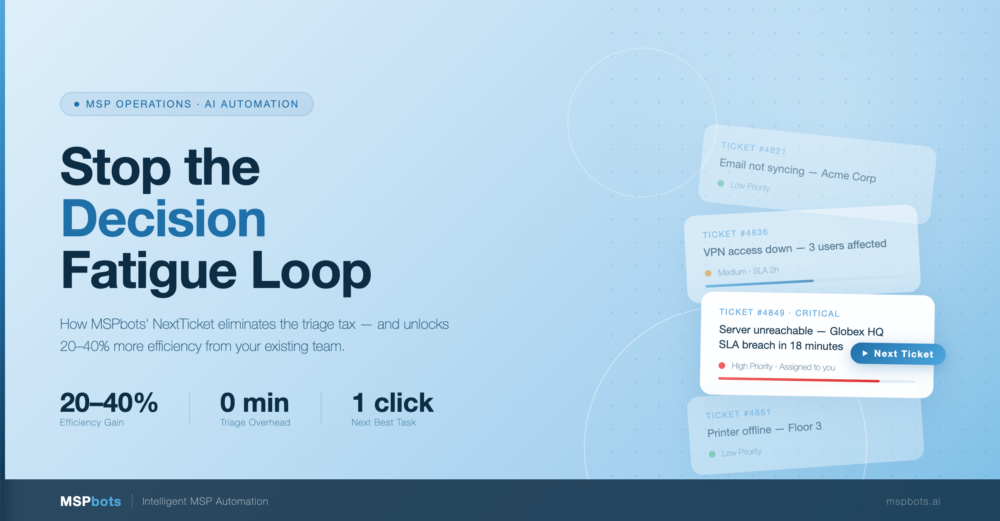
When a technician is ready for their next task, NextTicket surfaces the highest-priority ticket automatically. The system factors in SLA urgency, ticket age, client priority, technician skill alignment, and board-level context — and presents a single, clear next action. No queue-staring. No guessing. No cognitive overhead.
The result? Technicians go directly from finishing one ticket to starting the right next ticket, with zero administrative friction in between.
What Does “Presenting the Next Best Task” Actually Mean?
This isn’t just about sorting tickets by date or urgency alone. NextTicket applies intelligent logic that mirrors what an expert dispatcher would consider — but does it consistently, instantly, and without burnout.
The system ensures that:
- SLA breaches are prevented, not just reacted to, because at-risk tickets surface before they become violations
- High-value clients receive appropriate priority without relying on a technician to remember which accounts are Tier 1
- Skill-matched routing means the right engineer gets the right ticket — not just whoever happens to open the queue first
- Cherry-picking is eliminated, because technicians aren’t browsing the board; they’re receiving a directive
The net effect is a service desk that operates closer to a well-oiled machine than a reactive fire brigade.
Why Removing Administrative Burden Unlocks Technical Excellence
Here’s the part that really matters for your bottom line: when you remove the cognitive overhead of self-prioritization, you don’t just get faster ticket handling. You get better technical work.
Technicians want to develop skills in cloud platforms, automation, and security. When daily work revolves around repetitive triage and troubleshooting, there is little time for learning or experimentation — and talented professionals often leave environments where they feel stuck in reactive support roles.
When engineers trust that the system is managing prioritization intelligently, their mental energy is freed for what they’re actually hired to do: diagnose, resolve, and innovate. That cognitive bandwidth — previously burned on “what’s next?” — gets redirected into deeper diagnostics, cleaner documentation, and faster, more accurate resolution.
This is the mechanism behind the 20–40% efficiency gains MSPs see when implementing NextTicket. It’s not that technicians are suddenly working harder. It’s that they’re finally able to do their best work without an administrative tax on every hour of their day.
What Does a 20–40% Efficiency Gain Look Like in Practice?
Let’s make this concrete. Imagine your team currently resolves an average of 12 tickets per technician per day. A 20% efficiency improvement brings that to ~14–15 tickets — without adding headcount, extending hours, or burning anyone out.
For an 8-person team, that’s 16–24 additional resolved tickets per day. Per month, that’s somewhere between 320–480 more tickets closed — with the same people, the same tools, and significantly less stress.
| Metric | Before NextTicket | After NextTicket (est.) |
|---|---|---|
| Daily tickets per tech | 12 | 14–17 |
| Admin time per tech/day | 45–60 min | <10 min |
| Cognitive overhead score | High | Low |
| SLA breach risk | Reactive | Proactive |
| Technician satisfaction | Variable | Improved |
Does Reducing Decision Fatigue Actually Improve Technician Retention?
This is the question MSP owners often forget to ask — until they’re writing another job posting.
IT professionals who once enjoyed their work and willingly put in overtime find themselves feeling physically and emotionally exhausted, resentful, disengaged, and less productive after months or years of sustained stress. The MSP industry has a real retention problem, and a non-trivial part of it is structural: the environment creates cognitive overload as a matter of course.
When technicians don’t have to fight the board to find their next task, when they’re empowered to do deep technical work rather than administrative labor, when they finish a shift having resolved things rather than just triaged things — that’s a fundamentally different working experience. It’s one where skilled engineers can build momentum, develop expertise, and feel genuine satisfaction in their output.
Retention isn’t just a HR problem. It’s an operational efficiency problem. And the same tool that boosts your daily ticket throughput can also meaningfully reduce the invisible friction that drives your best people out the door.
Can Automation Really Replace the Judgment of an Experienced Dispatcher?
It’s a fair question, and the honest answer is: it depends on what you mean by “judgment.” The contextual, intuitive, relationship-aware calls that experienced dispatchers make? That human element still has value. But the mechanical, repetitive parts of dispatching — the constant scanning, sorting, and routing that constitute the bulk of the cognitive workload? Automation handles those better, faster, and more consistently.
MSPbots’ platform is built specifically for MSP operations data. It doesn’t just automate generically — it works within the PSA context your team already lives in, pulling real-time signals from your existing data to make smarter prioritization decisions than any individual can make reliably under cognitive load.
Getting Started: What Does NextTicket Implementation Look Like?
One of the most common concerns MSP operators raise is disruption. Will it change how my team works? Will technicians resist it? The short answer: the resistance usually evaporates within a week, because the immediate quality-of-life improvement is tangible.
Technicians who previously dreaded Monday morning queue reviews quickly discover that starting a shift with a clear “here’s your first ticket” prompt is just… better. Less stressful. More focused. And the board gets cleaner faster, which improves team morale across the board.
From an implementation standpoint, MSPbots integrates directly with leading PSA platforms, pulling your existing ticket data and applying NextTicket logic without requiring a wholesale overhaul of your workflows. The goal is to complement and enhance how your team operates — not replace everything they know.
Stop Letting Your Service Board Drain Your Team’s Best Work
Your technicians didn’t get into IT to spend their mornings arguing with a ticket queue. They got in to solve problems, develop expertise, and deliver the kind of service that makes clients genuinely loyal.
Decision fatigue is a silent tax on every one of those goals. It drains cognitive bandwidth before the real work starts, degrades decision quality as the day progresses, fuels burnout, and ultimately costs your MSP in throughput, SLA performance, and retention.
MSPbots’ NextTicket is purpose-built to eliminate that tax. By presenting the next best task automatically, your engineers stay in a state of focused, productive flow — and your service desk operates like the well-run operation your clients are paying for.
If your team is ready to stop triaging the triage and start doing the work they’re actually great at, it’s time to see what NextTicket can do for your MSP.
Ready to reduce decision fatigue on your service desk? Explore MSPbots and see NextTicket in action.
Have you noticed the signs of decision fatigue on your service desk? Share what’s worked for your team in the comments — or reach out to us directly. We’d love to hear how other MSPs are tackling this.
