Ticket Triage
Why MSPs Must Adopt AI Ticket Triage
October 13, 2025

When Every Minute Hurts Profitability
Picture your Monday morning help desk: tickets are pouring in, phones are ringing, and your service coordinator is still categorizing yesterday's backlog. Each ticket takes a couple of minutes to read, label, and route. Multiply that across hundreds per day, and the hidden cost of manual triage becomes a silent profit drain.
According to HDI's Service Desk Benchmark, just a few extra minutes in average handle time can significantly affect headcount. At 10 minutes per ticket, a technician handles about 400 tickets per month; at 15 minutes, that number drops to 270. Now imagine spending 5 minutes only on classification before the real work even begins.
Across MSPs, manual triage costs thousands of hours per year, slowing response times, eating into margins, and pushing SLAs to the edge.
Why You Should Care About AI Ticket Triage
For most MSPs, triage doesn't show up in dashboards, but it shapes your operational efficiency, cost per ticket, and SLA compliance. McKinsey reports that AI adopters in service operations achieve up to 40 percent productivity improvement and 30 percent faster resolution times. When AI handles triage, your team handles impact.
This isn't a theoretical efficiency gain anymore. Thread's agentic platform has processed 173 million tickets across more than 750 MSP partners at 96 percent triage accuracy, freeing up more than 490,000 technician hours in the process. And the shift is showing up at the platform level too: ConnectWise acquired zofiQ in January 2026 specifically to build agentic triage into its PSA. When the PSA vendors themselves are moving this fast, waiting isn't the safe option anymore.
What Is AI Ticket Triage?
AI Ticket Triage acts like a 24/7 real-time classifier that reads, classifies, and routes every ticket the instant it arrives. Instead of spending minutes on repetitive sorting, your coordinators and technicians focus on solving issues that actually matter.
How it works:
- A new ticket enters your PSA (ConnectWise or Autotask).
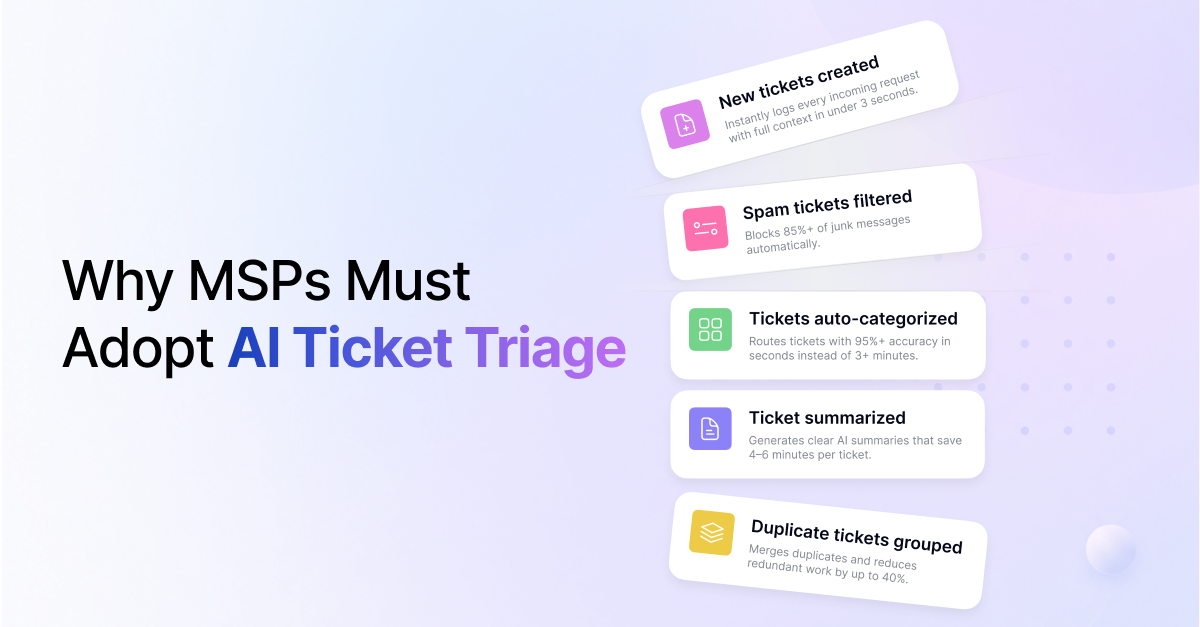
- AI reads the issue, understands context, and assigns the right board, type, subtype, and priority.
- It automatically detects duplicates or spam.
- It routes to the right board and adds a short AI-written summary and title.
The result: tickets reach the right technician faster, SLA performance improves, and your help desk runs with predictable, scalable efficiency.
What You Can Get from AI Ticket Triage
1. From Manual Bottlenecks to Instant Routing
Pain point: Coordinators lose 5 minutes per ticket just categorizing. For 1,500 tickets a month, that's 125 hours of wasted time.
Solution: AI triage routes tickets in seconds, freeing coordinators to focus on high-value oversight and client communication.
Business impact:
- Handle more tickets without adding headcount
- Prevent SLA breaches caused by triage delays
- Reallocate team time toward client satisfaction and retention
2. Consistent Accuracy That Learns Over Time
Pain point: Technicians label tickets differently. Misrouted tickets bounce between boards, frustrating both teams and clients.
Solution: AI triage applies consistent categorization and keeps learning from technician feedback to improve accuracy.
Business impact:
- Improve first contact resolution
- Reduce misrouted tickets and escalation workload
- Deliver a more predictable and professional client experience
3. Real Cost Savings and ROI
Pain point: Every manual minute costs money, and MSP margins are tight.
Solution: According to McKinsey's Global AI Survey, 44 percent of organizations using AI report direct cost reductions in operations. AI triage eliminates repetitive tasks that add no value.
Business impact:
- Lower cost per ticket
- Reinvest savings into client growth and service innovation
- Demonstrate clear ROI for leadership and investors
One midsize MSP estimated saving nearly $15,000 annually just by automating classification across 1,500 tickets a month, freeing a full-time coordinator's workload.
4. Smarter Automation That Evolves with You
Pain point: Traditional rule-based systems break whenever ticket categories or workflows change. Constant mapping eats time and frustrates admins.
Solution: AI triage uses natural language understanding to interpret real-world descriptions and adapt automatically to new issues and service patterns.
Business impact:
- Less admin overhead for operations and engineering
- Fewer rule updates and configuration errors
- Faster onboarding for new clients or services
5. Scale Without Limits, 24/7 Always-On
Pain point: Ticket surges can overwhelm your technician team.
Solution: AI triage operates continuously, handling peak volume without fatigue or delays.
Business impact:
- Maintain consistent response times even during ticket spikes
- Support growth and new contracts without proportional staffing
What Should MSPs Automate After Triage?
Triage is the entry point, not the destination. Once tickets are routed correctly, smart dispatch decides who actually handles them based on skill set and current workload, and ticket QA catches the incomplete notes and missing time entries before they hit the billing cycle. If you want to see where this is headed beyond triage, we cover the broader shift to agentic AI here.
Transform Triage into a Competitive Advantage
Your technicians spend more time solving, not sorting. Your coordinators focus on clients, not clicks. And your business gains the scalability, predictability, and profitability that manual triage will never deliver.
The MSPs that move first don't just save time. They set a new service standard that clients will come to expect.
Ready to See It in Action?
Want to see how AI triage performs with your actual ticket data? Book a demo and see how MSPbots can cut costs, protect SLAs, and transform your service desk into a profit engine.
October 13, 2025