Ticket Dispatch
How MSP Ticket Dispatch Automation Works: A Point-Based Deep Dive
August 4, 2026
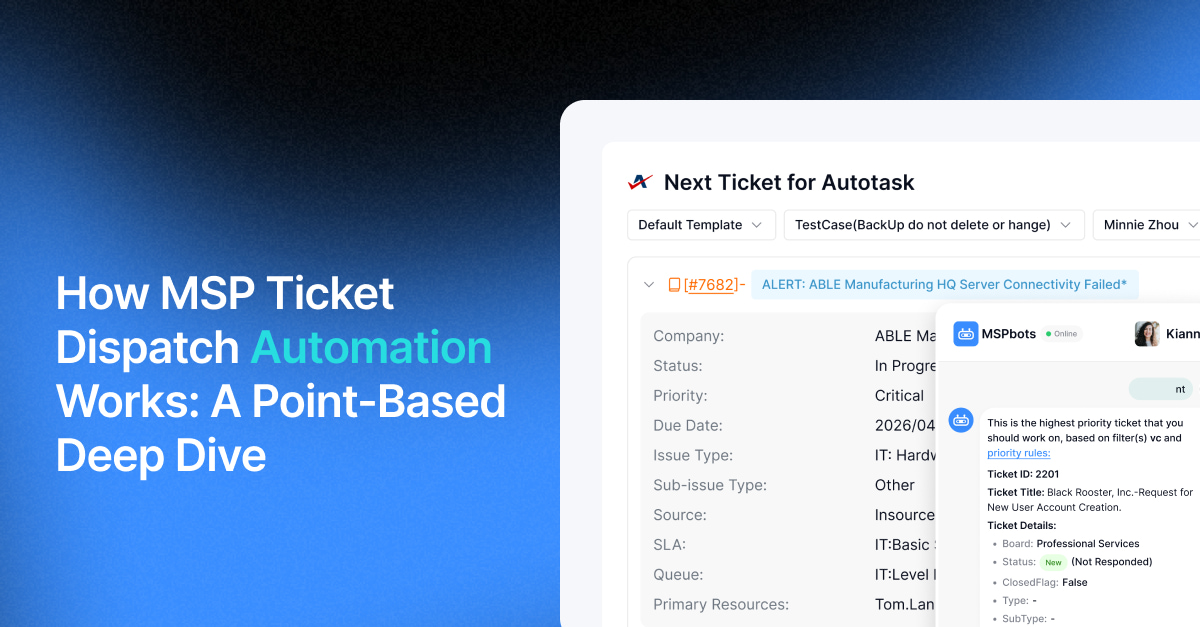

MSP ticket dispatch automation usually gets framed as a nice-to-have, something you get around to once the service desk stops being on fire. Talk to any MSP owner running more than a handful of technicians, though, and a more urgent problem shows up fast: whoever is manually assigning tickets today is also a single point of failure the day they call in sick, go on vacation, or leave the company.
The visible symptom is a queue that keeps growing. The less visible cost is fairness: even a good dispatcher develops blind spots, and technicians left to their own judgment naturally gravitate toward tickets that are quick and easy over the ones that are actually urgent. Point-based dispatch is a concrete answer to both problems. It isn't the same thing as "better triage." It's a mechanical system: tickets accumulate points based on defined factors, and technicians pull the highest-point ticket themselves instead of waiting for someone to hand it to them.
We already covered why dispatch queues break down in the first place in Why Your MSP Dispatch Queue Is Broken (and How to Fix It for Good). This piece goes further: how point-based dispatch actually works underneath the hood, how MSPs typically weight the factors, and how that weighting gets tuned once real tickets start flowing through it.
What Is MSP Ticket Dispatch Automation With Point-Based Scoring?
Point-based dispatch is a specific model within MSP ticket dispatch automation. Instead of a dispatcher, or the technicians themselves, deciding what to work on next, every open ticket carries a running point score. That score climbs automatically as conditions change: an SLA deadline gets closer, a high-tier client is affected, or a ticket sits unresolved for too long. Technicians don't get assigned tickets in the traditional sense. They pull the highest-scoring ticket in their queue themselves, because the ranking has already been done for them.
This is a meaningful shift from how most service desks operate today. A human dispatcher, even a great one, is working from partial information: their own sense of who's slammed, which clients complain the loudest, and which tickets look urgent based on a subject line. A point-based system works from the same data every time, applied consistently across every ticket, every technician, every hour of the day.
The Four Factors That Typically Drive Point Weighting
Most point-based dispatch configurations start from a similar core set of factors, then get adjusted for the realities of a specific MSP. The four that show up most consistently are SLA breach proximity, client tier, ticket age, and severity.
SLA Breach Proximity
This is usually the single heaviest-weighted factor, and for good reason. A ticket ten minutes from breaching its SLA needs to outrank almost everything else in the queue, because a breach carries a direct, contractual cost. Point-based systems typically apply an accelerating curve rather than a flat bump: points climb slowly at first, then rapidly in the final stretch before breach.
Client Tier
Not all clients carry equal weight, and pretending they do is its own kind of dishonesty. A premium-tier client's routine request often deserves to sit ahead of a lower-tier client's similar request, and point weighting lets MSPs encode that priority explicitly instead of leaving it to a dispatcher's memory of who complained last quarter.
Ticket Age
Age matters independently of SLA status, because tickets can sit in a queue without formally breaching anything while still testing a client's patience. A steady, modest point increase for every hour a ticket goes untouched prevents the quiet problem of tickets that are technically compliant but practically ignored.
Severity
Severity captures how much technical damage is happening right now: a server down versus a single user's printer not working. Severity is usually weighted heavily but capped, so a high-severity, low-tier ticket doesn't permanently outrank an aging, SLA-critical ticket from a premium client. Getting that cap right is exactly the kind of tuning MSPs do in the first few weeks of running the system live.
How Does Point-Based Dispatch Prevent Ticket Cherry-Picking?
Cherry-picking is one of the most persistent, least discussed problems in any service desk that lets technicians choose their own work. Left unmanaged, technicians gravitate toward quick, easy wins: password resets, simple software requests, anything with a fast resolution and a happy client. The tickets that get left behind are the complex, unpleasant ones, which are often exactly the tickets closest to breaching an SLA.
Point-based dispatch removes the choice, not the technician's autonomy. A technician still pulls their own next ticket, but the highest-point ticket in their queue is the one waiting, whether or not it looks appealing. This also removes the single-point-of-failure risk that comes with relying on one dispatcher: nothing in the process depends on a specific person being present, informed, or unbiased on a given day.
The result is a queue that self-corrects. Difficult tickets don't get orphaned because nobody wants them. They simply accumulate points until they become the obvious next pull for whoever is free.
Real Results: What Point-Based Dispatch Looks Like in Practice
The mechanics of MSP ticket dispatch automation described above aren't theoretical. Bold ICT, an eight-person MSP in Bendigo, Australia running Autotask, adopted Next Ticket specifically to get out of the business of manual dispatching. Their open queue dropped from a range of 150 to 200 tickets down to 60 to 80, roughly a 65 percent reduction, and the half a day per month the team used to spend on board reporting disappeared entirely. As founder Joel Gaskell put it: "The guys don't have to think about what they're going to work on next. We don't have to hire a dispatcher."
Computers Made Easy (Robo.net), a two-office MSP spanning Vancouver, Washington and Austin, Texas, was in the middle of an ITIL migration when cherry-picking became an obvious risk to manage. As Cody Masters explained: "Without Next Ticket, I would be concerned that technicians... would naturally gravitate toward incidents, causing requests to be overlooked." Point-based dispatch removed that risk directly, and manual spreadsheet reporting was eliminated in the process.
Excellent Networks, which grew from a solo founder to a seven-person team serving roughly 90 clients, used the same underlying automation to eliminate a full-time dispatcher role outright. Founder Mark Luna described the pressure plainly: "In order for us to compete with bigger MSPs we don't have the manpower, so we have to be quick. The bots help us do that."
MSPTeam SizeBeforeAfterBold ICT8 technicians150 to 200 open tickets, manual board reporting60 to 80 open tickets (about 65% fewer), reporting eliminatedComputers Made Easy (Robo.net)Two officesManual spreadsheet reporting, cherry-picking riskManual reporting eliminated, no dispatcher neededExcellent Networks7 people, about 90 clientsDedicated dispatcher roleDispatcher role eliminated
How MSP Ticket Dispatch Automation Gets Tuned in the First Few Weeks
No MSP gets weighting perfect on day one, and the ones who get the most value out of MSP ticket dispatch automation treat the first few weeks as a calibration period, not a launch-and-forget event.
The typical pattern looks like this: in week one, most MSPs start conservative, weighting SLA proximity heavily and everything else lightly, just to confirm the mechanism works and technicians trust it. By week two or three, patterns start showing up. Maybe severity is too dominant and urgent-but-low-effort tickets are jumping ahead of aging, client-tier work. Or ticket age is climbing too fast and creating noise around tickets that aren't actually at risk yet.
By week four, most MSPs land on a weighting scheme that reflects their actual client mix and contract structure rather than a generic default. This is also where visibility matters: MSPs that can see ticket triage and severity classification data alongside dispatch scoring make these adjustments faster, because they aren't guessing at why a ticket landed where it did.
What Should MSPs Ask Before Trusting a Point-Based Queue?
It's a reasonable question, and one we hear often from MSPs evaluating this kind of system for the first time: what exactly is happening under the hood? One MSP we spoke with during an evaluation put it directly. They wanted to understand the specific point weighting logic, for example how much weight an approaching SLA breach actually gets, before they were willing to trust it with a live queue.
That instinct is the right one. Before adopting point-based dispatch, MSPs should ask a vendor to show, not just describe, how each factor is weighted, whether those weights are visible and adjustable, and whether technicians can see why a ticket ranks where it does. A system that can't explain its own ranking in plain terms isn't ready for a live queue, no matter how sophisticated the underlying logic is.
MSPs should also ask how quickly weighting can be changed once live data starts coming in. A system that requires a support ticket and a two-week wait to adjust one factor won't keep up with the tuning process described above, and tuning is where most of the real value gets captured.
Point-based dispatch isn't a magic fix for a broken service desk. It's a mechanism that makes existing priorities visible, consistent, and enforceable without needing a person to enforce them every hour of every day. The MSPs getting the most out of it aren't the ones with the fanciest weighting formula on day one. They're the ones willing to watch, adjust, and treat the first month as tuning rather than a finished product.
MSPbots' Next Ticket is built around exactly this model: point-based prioritization that technicians pull from directly, with weighting that stays visible and adjustable as your service desk changes. If you're still relying on one person to keep the queue moving, or your queue is drifting the way it does when cherry-picking is happening quietly, it might be worth a demo to see the weighting logic yourself.
August 4, 2026